Overview
Thought Pudding is a mental health platform focused on helping individuals begin their therapy journey in a structured and comfortable way. The objective of this engagement was to improve the efficiency of the brand’s Meta lead generation campaigns by refining messaging and identifying stronger-performing creative formats.
Instead of aggressive scaling or frequent campaign restructuring, the strategy focused on improving lead quality and cost efficiency through better messaging alignment and structured creative testing.
A key insight during the optimization process was clear:
Video creatives performed significantly better than static formats for therapy-entry communication.
By shifting creative direction toward video-led storytelling and reassurance-based positioning, we were able to stabilize campaign performance and improve lead acquisition efficiency.
Initial Situation
At the start of the engagement:
- Meta lead generation campaigns were already active
- Average CPL was approximately ₹400
- Messaging lacked emotional alignment with first-time therapy seekers
- Creatives were not addressing hesitation barriers clearly
- Static creatives were dominating delivery but not maximizing performance
- Video formats were underutilized despite strong potential for therapy-entry messaging
The goal was not only to reduce CPL but to improve lead intent quality through stronger communication positioning.
Strategy Implemented
The campaign improvement strategy focused on three core pillars:
- audience understanding
- messaging refinement
- video-first creative testing framework
This ensured performance improvement came from communication strength rather than short-term optimization tactics.
Step 1: Ideal Customer Profiling
Before introducing new creative directions, the focus was placed on understanding therapy-first-time users.
We identified:
- hesitation before first therapy conversation
- emotional uncertainty around seeking support
- trust requirements in mental health communication
- expectation of a guided therapy entry experience
This helped reposition messaging from awareness-style communication to comfort-first therapy-entry positioning.
Step 2: Messaging Direction Shift
The communication tone was adjusted to better match first-time therapy seekers.
Instead of direct promotional messaging, creatives emphasized:
- safe therapy entry experience
- guided mental health support
- structured first consultation journey
- reassurance around starting therapy for the first time
This shift improved engagement quality and reduced hesitation-driven drop-offs inside the lead funnel.
Step 3: Video-Led Creative Strategy Implementation
During testing, one important pattern became clear:
Video creatives were consistently outperforming static creatives in engagement and lead behavior quality.
Because therapy is a sensitive category, users respond better to communication that feels human, supportive, and conversational.
So the strategy shifted toward:
- short reassurance-style videos
- therapy-entry explanation videos
- structured conversation-led creatives
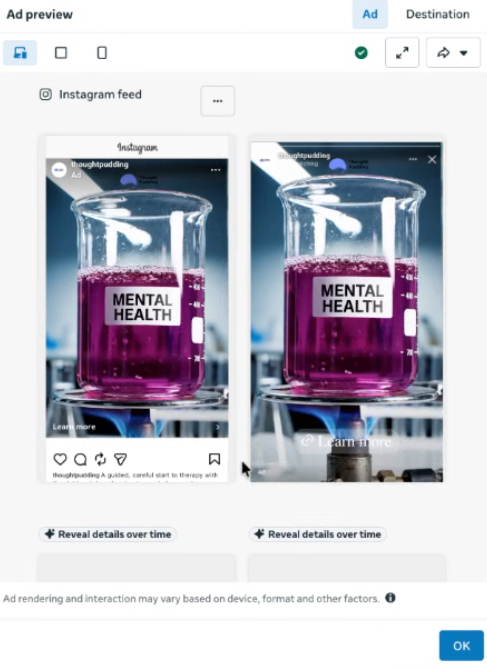
- science-style mental health narrative visuals
Video creatives helped:
- build trust faster
- explain therapy journey clearly
- reduce psychological hesitation
- improve message clarity
This directly improved campaign interaction quality.
Step 4: Structured Creative Production Workflow
Creative execution followed a structured workflow instead of random experimentation.
The process included:
- concept ideation
- script direction planning
- message alignment validation
- shoot coordination guidance
- editing supervision
- testing deployment planning
Where required, founder-aligned messaging inputs were incorporated to maintain authenticity and trust tone consistency.
This ensured creatives matched therapy-entry positioning accurately.
Step 5: Iterative Video Creative Testing
Multiple video communication angles were tested to identify the strongest therapy-entry positioning.
Testing included:
- reassurance-based therapy introduction videos
- structured consultation explanation videos
- science-style mental health visual storytelling
- hesitation-reduction messaging formats
One of the strongest performing directions used science-style narrative visuals, which helped communicate therapy in a structured and credible way.
This improved engagement behavior and reduced friction during lead submission.
February Campaign Performance
Before optimization improvements were applied:
- Average CPL: approximately ₹400
- Messaging relied more on earlier static formats
- Therapy-entry hesitation barriers were not clearly addressed
- Video creative contribution to delivery was limited
Campaign structure at this stage required repositioning through stronger communication alignment.
March Campaign Performance After Optimization
After introducing video-led messaging improvements:
- Average CPL improved to approximately ₹350
- engagement quality improved
- therapy-entry hesitation reduced
- message clarity increased
- delivery stability improved
While the numerical CPL drop appears moderate, the improvement came from stronger audience alignment and better lead intent quality, which made the campaign more scalable.
Key Performance Improvements Achieved
Through structured optimization:
- campaign messaging aligned better with therapy-new users
- hesitation-driven drop-offs reduced
- creative engagement improved
- lead acquisition efficiency increased
- CPL stabilized at a lower range
- campaign structure became more scalable
Most importantly, performance improvement came from positioning strength rather than aggressive budget manipulation.
Conclusion
The Meta Ads lead generation campaign for Thought Pudding shows how performance improvements in sensitive categories like mental health often come from stronger messaging and the right creative format—not just higher budgets or campaign restructuring. By shifting the communication approach toward reassurance-based therapy-entry positioning and prioritizing video creatives over static formats, we were able to improve engagement quality, reduce hesitation from first-time therapy seekers, and stabilize CPL from around ₹400 to approximately ₹350. More importantly, the campaign evolved into a more reliable lead acquisition system where video-led storytelling helped build trust faster and encouraged users to take their first step toward therapy with greater confidence.
If you’re running Meta lead generation campaigns and struggling with high CPL, low-quality leads, or weak engagement signals, a structured video-first creative testing approach can significantly improve performance. Feel free to reach out if you’d like help building a similar messaging-led Meta Ads framework for your brand