Search has changed a lot. People are no longer just typing keywords into Google and clicking links. They’re asking voice assistants questions, getting AI-generated answers, and discovering information through new search experiences. For businesses, this means being visible in traditional search is no longer the only part of a successful digital strategy.
At Viral Groww, we help businesses adapt to this changing search landscape by building strategies that go beyond traditional SEO. From improving organic search visibility to creating content that answers user questions and strengthens visibility across AI-powered search experiences, our approach focuses on helping brands stay discoverable as search continues to evolve.
This guide is for marketers, content creators, and business owners who want to understand how search is changing in 2026 and what SEO, AEO, and GEO mean for their online visibility.
Here’s what we’ll walk through:
- The difference between SEO, AEO, and GEO and the role each approach plays in modern search visibility.
- How AI-powered search is changing user behavior and why businesses need to think beyond traditional search results.
- How to build a connected search strategy using SEO, AEO, and GEO to create stronger visibility across different search experiences.
By the end, you’ll have a clearer understanding of how these three approaches work together and how businesses can prepare their content for the evolving search landscape.
This guide is for marketers, content creators, and business owners who want to stay ahead of how search works in 2026, not how it worked five years ago.
Here’s what we’ll walk through:
- The difference between SEO, AEO, and GEO and why each one plays a different role in your visibility
- How AI-powered search has shifted user behavior, making Answer Engine Optimization and Generative Engine Optimization just as important as traditional search
- How to build a search strategy that uses all three so you’re not leaving traffic on the table
By the end, you’ll know exactly where to focus your energy and how to show up no matter how someone searches.
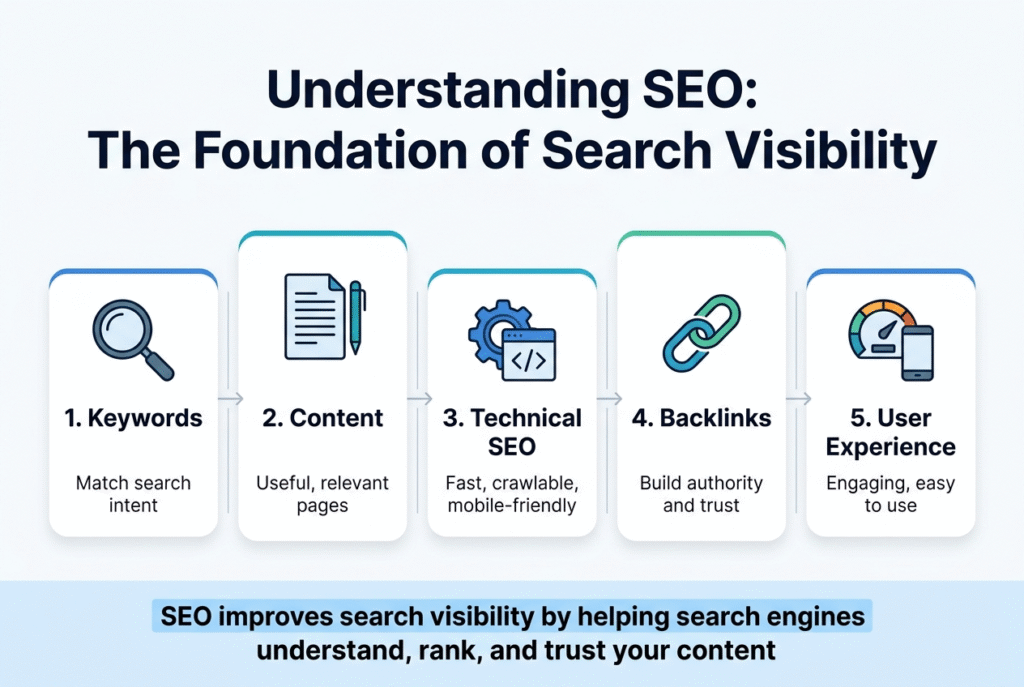
Understanding SEO: The Foundation of Search Visibility
What SEO Means and Why It Still Matters in 2026
SEO (Search Engine Optimization) is the practice of making your content easy for search engines to find, understand, and rank. Despite constant algorithm updates and the rise of AI search tools, SEO remains the backbone of organic visibility. Without it, even great content stays invisible.
How Search Engines Rank and Index Content
Search engines crawl web pages, store them in an index, and rank them based on hundreds of signals:
- Relevance – Does the content match the search query?
- Authority – How many quality sites link to it?
- Experience – Is the page fast, mobile-friendly, and easy to navigate?
- Content quality – Is it genuinely helpful and accurate?
Core SEO Techniques That Drive Organic Traffic
- Keyword research and strategic placement
- On-page optimization (titles, meta descriptions, headers)
- Link building from authoritative sources
- Technical SEO (site speed, crawlability, structured data)
- Consistent, high-quality content creation
Limitations of Traditional SEO in a Changing Search Landscape
Traditional SEO struggles when:
- Users ask conversational questions expecting direct answers
- AI-generated summaries appear before organic results
- Zero-click searches reduce traffic even for top-ranking pages
SEO alone no longer guarantees visibility — which is exactly where AEO and GEO step in.
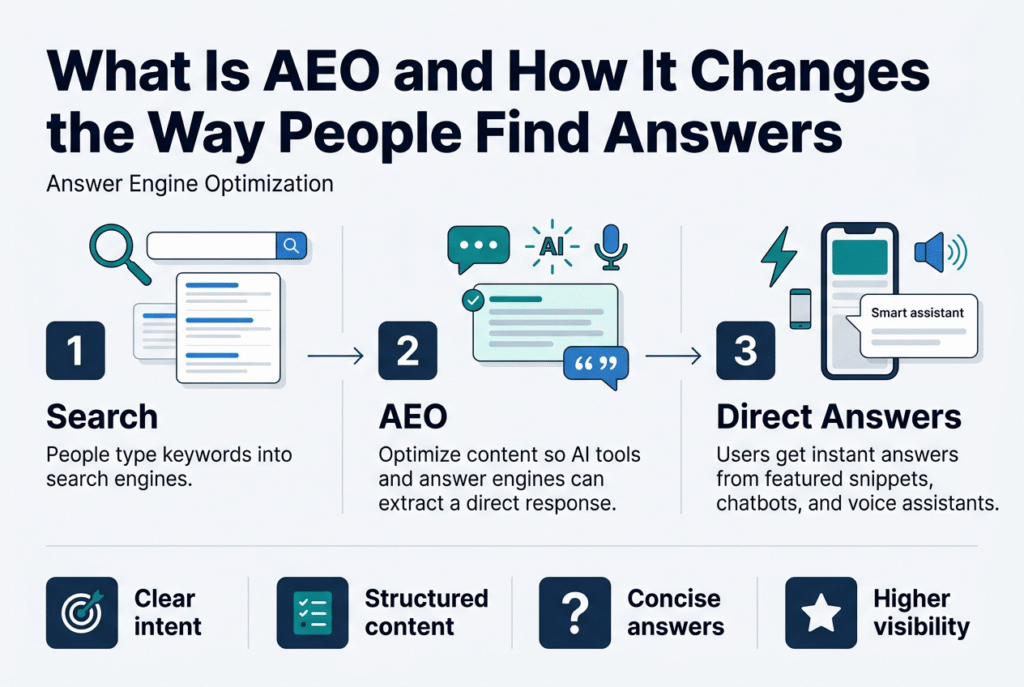
What Is AEO and How It Changes the Way People Find Answers
The Rise of Answer Engines and Voice Search
Search behavior has shifted dramatically. People no longer just search — they ask. Voice assistants like Siri, Alexa, and Google Assistant have trained users to expect instant, conversational answers rather than a list of blue links.
Answer Engine Optimization (AEO) is the practice of structuring content so these platforms can pull direct, accurate answers from your pages.
How AEO Optimizes Content for Direct Answers
AEO focuses on:
- Writing in clear, question-and-answer formats
- Using structured data (Schema markup) to label content
- Keeping answers concise, typically under 50 words for voice results
- Matching natural language queries
Featured Snippets, Knowledge Panels, and Position Zero
AEO targets high-visibility placements:
- Featured Snippets — boxed answers above organic results
- Knowledge Panels — brand/entity information on the right side
- Position Zero — the answer Google reads aloud for voice searches
Why AEO Matters More as Zero-Click Searches Grow
Over 60% of searches now end without a click. If your content isn’t the answer, someone else’s is.
Key Differences Between AEO and Traditional SEO
| Factor | SEO | AEO |
| Goal | Rankings | Direct answers |
| Format | Long-form pages | Concise Q&A |
| Target | Search engines | Answer engines |
| Metric | Clicks | Visibility/authority |
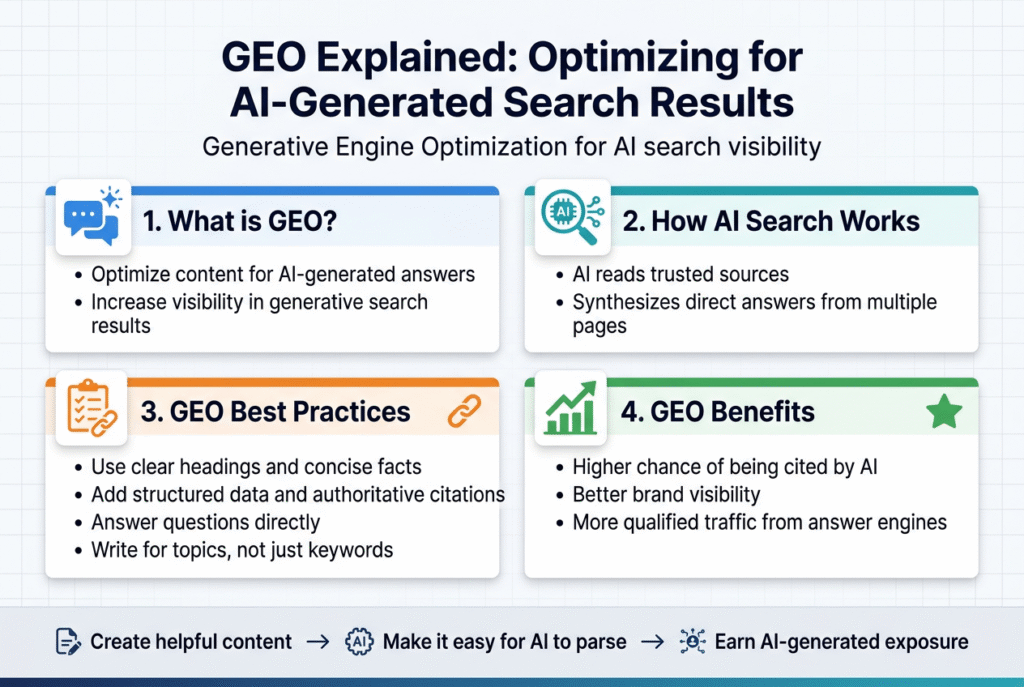
GEO Explained: Optimizing for AI-Generated Search Results
What Generative Engine Optimization Actually Means
GEO is the practice of making your content easy for AI systems — like ChatGPT, Google’s AI Overviews, and Perplexity — to find, understand, and reference in their generated responses. Unlike traditional SEO, you’re not chasing rankings. You’re positioning your content as a trusted source AI pulls from when answering user questions.
How AI Overviews and Chatbots Pull and Cite Content
AI systems scan indexed content, prioritizing:
- Clear, factual statements that directly answer questions
- Authoritative sources with strong backlink profiles
- Structured data and well-organized page formatting
- Recent, accurate information that aligns with user intent
These systems synthesize multiple sources, so even mid-ranking pages can get cited if the content is clear and credible.
Content Strategies That Improve Visibility in AI Responses
- Write direct answers within the first 100 words
- Use FAQ sections with concise, conversational responses
- Add statistics, quotes, and citations from credible sources
- Structure content with headers that mirror natural questions
- Keep sentences short and scannable
Why GEO Represents the Next Frontier of Search
Search behavior is shifting fast. More users skip the results page entirely and trust AI-generated answers. Brands that optimize for AI citation now will own that visibility before their competitors even realize the game has changed.
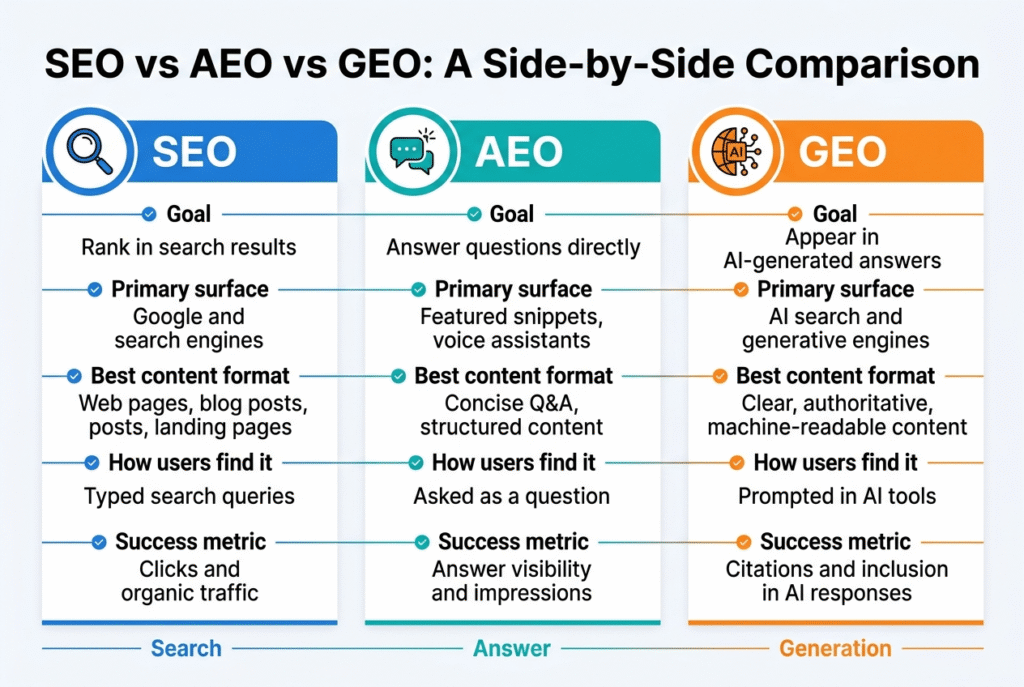
SEO vs AEO vs GEO: A Side-by-Side Comparison
Goals and Intent Behind Each Optimization Approach
Each discipline solves a different problem:
- SEO drives organic traffic by ranking pages on traditional search engine results pages (SERPs). The goal is visibility and clicks.
- AEO (Answer Engine Optimization) positions your content as the direct answer to a specific question — think featured snippets, voice search, and zero-click results.
- GEO (Generative Engine Optimization) gets your brand cited inside AI-generated responses from tools like ChatGPT, Perplexity, and Google’s AI Overviews.
How Each Strategy Targets Different Search Behaviors
| Strategy | Search Behavior Targeted | Primary Channels |
| SEO | Keyword-driven browsing | Google, Bing SERPs |
| AEO | Question-based, conversational queries | Voice assistants, featured snippets |
| GEO | AI-assisted research and discovery | ChatGPT, Perplexity, AI Overviews |
Metrics Used to Measure Success in Each Approach
- SEO: Organic traffic, keyword rankings, click-through rate (CTR), domain authority
- AEO: Featured snippet wins, voice search appearances, zero-click impression share
- GEO: Brand mention frequency in AI responses, citation rate, share of AI-generated answer visibility
Tracking all three separately helps you spot gaps in your overall search presence before they cost you.
How to Build a Winning Search Strategy That Combines All Three ?
Identifying Which Approach Fits Your Business Goals
Your starting point depends on what you’re actually trying to achieve:
- Local service business? Prioritize SEO for rankings, then layer AEO for quick-answer queries
- E-commerce brand? SEO drives product discovery; GEO helps you appear in AI shopping recommendations
- B2B SaaS? GEO and AEO matter most — buyers increasingly use AI tools to research solutions
Creating Content That Satisfies SEO, AEO, and GEO Together
The good news: one well-structured piece can check all three boxes.
- Write long-form content with clear headers (SEO)
- Add FAQ sections using natural question phrasing (AEO)
- Include cited statistics, author credentials, and structured data (GEO)
Tools and Resources to Manage a Multi-Strategy Approach
| Goal | Tool |
| SEO tracking | Ahrefs, Semrush |
| Featured snippet monitoring | AlsoAsked, AnswerThePublic |
| GEO visibility tracking | Search Atlas, Profound |
| Schema implementation | Google’s Rich Results Test |
Common Mistakes to Avoid When Balancing All Three Methods
- Treating each strategy as completely separate they share foundational content
- Chasing every tactic without measuring what’s actually driving traffic
- Ignoring E-E-A-T signals, which GEO and AEO both depend on heavily
- Publishing thin content stuffed with questions but lacking real depth
The search landscape has changed a lot, and keeping up means understanding that SEO, AEO, and GEO are no longer interchangeable ideas. SEO helps your content appear in traditional search results, AEO focuses on providing direct answers for search features and voice-based queries, while GEO helps improve your brand’s visibility across AI-powered search experiences. Each approach serves a different purpose, but together they create a more complete strategy for staying discoverable as the way people search continues to evolve.
At Viral Groww, we believe the smartest approach is to treat SEO, AEO, and GEO as connected parts of one search strategy rather than completely separate tactics. Create content that can rank in search results, answer real user questions clearly, and build the relevance and authority needed to be recognized across AI-powered platforms. In 2026, businesses need to think beyond page-one rankings and focus on building visibility across the different ways people discover information online.